
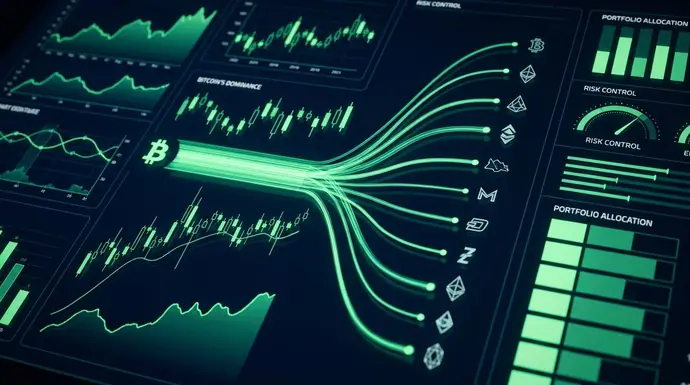

Altcoin trading strategy has to start with a less exciting question than most traders want to ask: is the market actually rewarding risk right now? At the 6:05 a.m. PT Yahoo Finance snapshot for this run, Bitcoin was trading near $77,114 and Ether near $2,313, while the Fear & Greed reading was unavailable at fetch time. Those are point-in-time market references, not signals by themselves. The mix argues for patience. The setup is not dead, but it is selective.
That is the useful frame for 2026. The easy version of altcoin season, where almost any token with liquidity can run for weeks, is not the base case. Bitcoin dominance remains the first chart to watch. If capital is still hiding in BTC and stablecoins, an altcoin trader needs a tighter playbook: stronger filters, smaller position sizes, and faster invalidation.

Altcoin trading strategy starts with market regime
The first mistake is treating every altcoin setup the same. A breakout in a broad risk-on market is different from a breakout in a Bitcoin-led market where smaller tokens are only getting brief sympathy bids. The chart may look similar. The odds are not.
A practical regime check starts with four inputs: Bitcoin trend, Bitcoin dominance, Ether strength, and total crypto market breadth. If BTC is rising while dominance rises too, capital is concentrating. In that environment, altcoins can still bounce, but many moves fade quickly. If BTC holds trend while dominance falls and ETH/BTC strengthens, the market is giving altcoins more room.
That distinction matters because strategy follows regime. Momentum traders can press breakouts when breadth is improving. Range traders should be more careful when only a handful of large-cap coins are moving. Newer traders should read our crypto technical analysis guide before assuming every green candle is confirmation.
Trade Altcoins With a Defined Plan
Bitunix gives active traders futures markets, mobile execution, and up to $5,500 in bonus rewards for eligible new users.
Build the watchlist before the trade
A good altcoin trading strategy does not begin after a token is already trending on social media. By then, spreads are wider, funding can be worse, and late buyers are usually fighting each other for exit liquidity.
The cleaner approach is to build a watchlist before the move. Start with liquid names that trade on reputable venues. Then divide them by sector: layer-1s, AI tokens, DeFi, exchange tokens, gaming, meme coins, and infrastructure. The point is not to predict every winner. The point is to know which coins should move together and which one is showing relative strength first.
Relative strength is the trader's filter. If Solana ecosystem tokens are moving but one name cannot reclaim a prior support level, skip it. If a DeFi token is making higher lows while its peers are flat, it deserves a closer look. Traders who need a basic tooling stack can start with our breakdown of crypto trading tools.
Volume matters too. Thin altcoins can produce beautiful percentage gains on paper and ugly fills in real trading. If the order book cannot absorb your position without moving the price, the chart is lying about your risk.
Altcoin trading strategy needs strict invalidation
Most altcoin losses do not come from being wrong once. They come from staying wrong while volatility keeps expanding. That is why invalidation has to be defined before entry.
For spot trades, invalidation can be a daily close below a breakout level, a loss of the prior higher low, or a failed reclaim after a retest. For futures trades, the level has to be tighter because leverage makes waiting expensive. A trader using perpetuals should understand funding, liquidation distance, and margin mode before sizing up. Our explainer on what perpetual futures are is the right starting point.
A simple rule works better than a clever one: if the reason for the trade disappears, exit. Do not downgrade a trade into an investment because the stop is close. Do not call a failed breakout a long-term thesis. That mental switch is where small losses become portfolio damage.
Position sizing is the real edge
Altcoins are volatile enough that position sizing often matters more than entry precision. A trader can catch the right coin and still lose money if the position is too large for the expected pullback.
One workable framework is to risk a fixed percentage of account equity per trade, usually 0.5% to 2% depending on experience and volatility. The wider the stop, the smaller the position. The thinner the token, the smaller the position. The more correlated the watchlist, the smaller each individual position should be.
Correlation is underrated. Holding five high-beta altcoins is not diversification if all five sell off when Bitcoin drops 3%. In a risk-off tape, altcoin baskets often behave like one oversized position. Traders managing futures exposure should revisit our crypto futures position sizing guide before adding leverage.
Keep Risk Controls Close
If you trade volatile altcoins, use clear stops, measured size, and Bitunix's up to $5,500 bonus offer without treating bonus capital as permission to overtrade.
Use catalysts, but do not marry them
Catalysts can help an altcoin trade, especially when the market is already leaning risk-on. Token release schedules, network upgrades, exchange listings, ETF speculation, protocol revenue, and ecosystem grants can all pull attention into a coin. Attention, though, is not the same as durable demand.
The stronger setup is a catalyst plus confirmation. If a token has news but no volume, no relative strength, and no clean market structure, the trade is probably early or wrong. If the news arrives after a 70% move, the trade may already be crowded.
Traders should also separate narratives from mechanics. Meme coins can move on community energy, but they can also unwind faster than large caps. DeFi tokens may have revenue, yet still trade poorly if token emissions swamp demand. Exchange tokens can benefit from platform growth, but they carry venue-specific risk. The trade has to fit the token's actual structure.
Bottom line
An altcoin trading strategy for 2026 should be selective, not heroic. Start with market regime. Build the watchlist before the crowd arrives. Trade relative strength, define invalidation, and size positions as if Bitcoin can interrupt the setup at any time.
The goal is not to catch every altcoin move. It is to survive enough bad signals to be present for the few clean ones. In this market, that is still an edge.