

How to Trade Cryptocurrency: A Beginner's Complete Guide for 2026
If you want to learn how to trade cryptocurrency in 2026, start with one hard truth: crypto rewards discipline far more than bravado. Bitcoin is trading at $68,182, up 1.25% on the day, while Ether sits at $2,002, up 2.88%. At the same time, the Fear & Greed Index is at 8, deep in Extreme Fear. That mix matters. Panic can create attractive entries, but it also creates the kind of volatility that punishes beginners who jump in without a plan.
The good news is that trading crypto is not mysterious. The mechanics are straightforward once you understand how exchanges work, what kind of orders to place, and how much risk you can take on without blowing up your account. The bad news is that many newcomers skip those basics and head straight for futures on margin. That is usually where the tuition gets expensive.
This guide walks through the process step by step, from opening an exchange account to placing your first trade and managing risk when the market turns ugly.
How to trade cryptocurrency by setting up the right exchange account
Your first decision is where to trade. For most beginners, large centralized exchanges such as Coinbase, Kraken, Binance, or Bybit offer the easiest on-ramp because they combine fiat deposits, spot markets, and a cleaner interface than most decentralized alternatives. Ease of use matters. So does security.
Start with the standard setup:
- Create an account with a strong unique password.
- Enable two-factor authentication right away, preferably with an authenticator app instead of SMS.
- Complete identity verification, which usually means a government ID, personal details, and a selfie check.
- Fund the account through bank transfer, debit card, or stablecoin deposit.
- Set basic security protections such as withdrawal whitelists and anti-phishing codes when available.
Do not rush this part. Sloppy setup is one of the easiest ways to lose money before you even place a trade. If you plan to hold coins for more than a short period, read our guide on how to secure your crypto wallet as a beginner. Exchanges are for trading. Long-term storage is a different job.
For most new traders, spot trading should be the default. You buy the asset, you own the asset, and your downside is capped at the amount you put in. That is a far better training ground than perpetual futures, where a bad trade can unravel fast.
Ready to Start Trading Crypto?
Put your knowledge to work on Bitunix with up to $5,500 in welcome bonuses for new traders.
How to trade cryptocurrency on spot markets before touching futures
Spot trading means buying or selling the actual coin at the current market price or at a price you choose. If you buy 0.05 BTC on spot, you own 0.05 BTC. Simple. Futures trading is different. You are trading a contract tied to price movement, often with borrowed capital attached.
Here is my view: beginners should treat margin trading as optional at best and dangerous by default. Yes, it can magnify gains. It also magnifies mistakes, and beginners make a lot of mistakes. On 10x borrowed exposure, a relatively small move against your position can wipe out your margin. On 25x or 50x, the room for error gets laughably thin.
That does not mean you should ignore derivatives altogether. It means you should understand them before risking money. If you want a deeper primer, our walkthrough on getting started with crypto futures trading explains how these products work. If you eventually trade futures, you also need a clear plan for liquidation risk. This guide on how to avoid getting liquidated in futures is required reading.
There is another reason to start with spot in a market like this one. Extreme fear often creates violent bounces, but those bounces do not always hold. Spot gives you more room to be early without getting forcibly closed by the exchange. That flexibility is valuable when sentiment is fragile.
Key tools you need to know to trade well
Most bad trades begin before the order is placed. The trader has no entry plan, no exit plan, and no sense of what the chart is actually saying. You do not need to become a full-time technician, but you do need a working toolkit.
Order types
- Market order: buys or sells immediately at the best available price. Fast, but not precise.
- Limit order: executes only at your chosen price or better. Better control, but it may not fill.
- Stop-loss order: closes the trade if price hits a level that proves your setup wrong.
If you are asking how to trade cryptocurrency without making rookie errors, here is one answer: stop using market orders for everything. In liquid pairs they are fine when speed matters, but beginners often overpay on entries and panic out on exits. Limit orders force you to think.
Charts and price structure
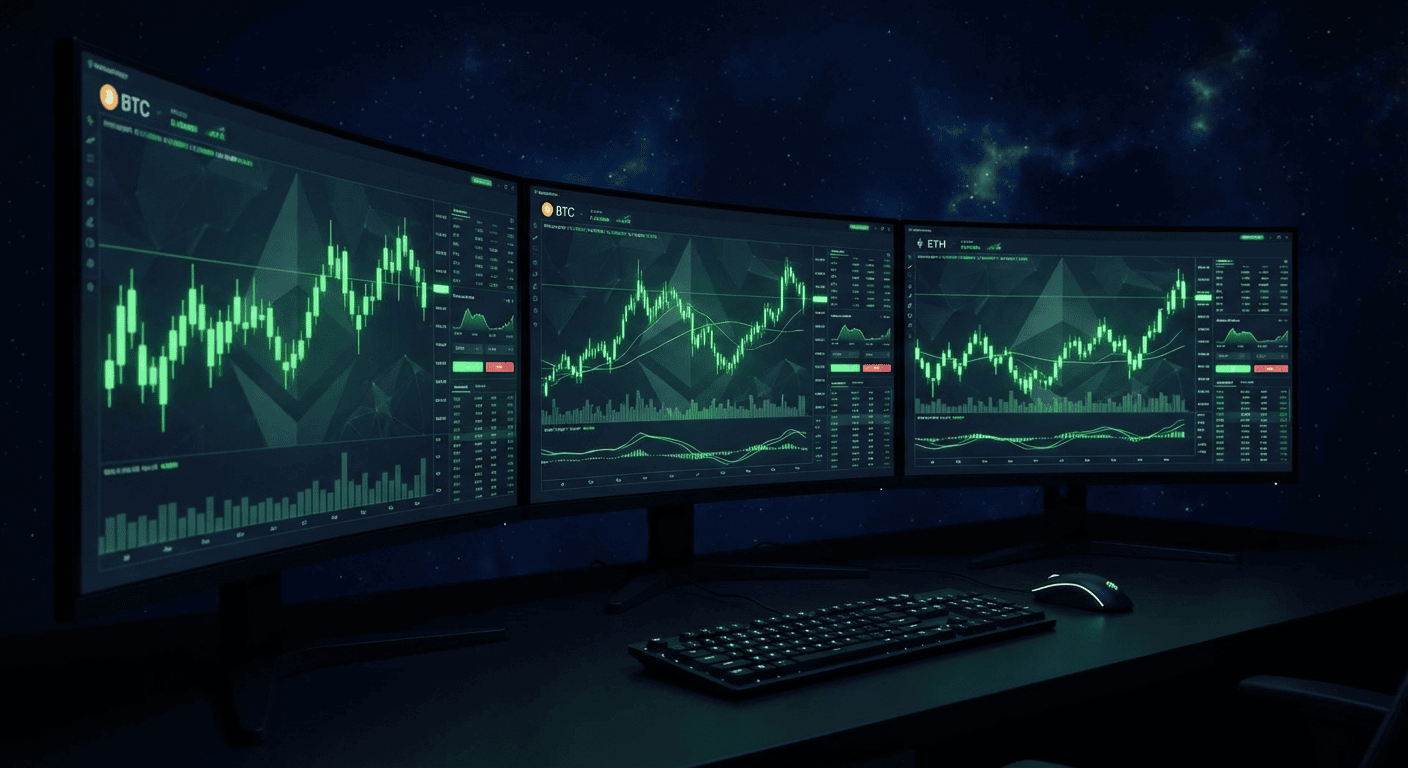
Candlestick charts remain the standard for a reason. Each candle shows the open, close, high, and low for a set time period. That gives you context fast. Volume matters too. A move on strong volume tends to carry more weight than a move on thin participation.
You do not need fifty indicators. Start with support, resistance, trend direction, and volume. If you want a cleaner foundation, read our beginner's guide to reading crypto charts. Most traders would be better off mastering those basics than cluttering their screen with lagging signals.
Entries and exits
Before entering a trade, answer three questions:
- Where am I getting in?
- Where am I getting out if I am right?
- Where am I getting out if I am wrong?
If you cannot answer all three, you do not have a trade. You have a hunch.
How to trade cryptocurrency without getting wrecked by risk
Risk management is the dividing line between traders who last and traders who disappear. This is even more true when the Fear & Greed Index is stuck at 8. Extreme fear can produce bargain entries for patient buyers, but it can also bring fast drops, fake breakouts, and overnight volatility that feels irrational in the moment.
The simplest rule is still one of the best: risk only 1% to 2% of your trading capital on a single position. If your account is $2,000, your maximum planned loss on one trade should usually stay in the $20 to $40 range. That rule feels conservative until you hit a losing streak. Then it feels like oxygen.
Position sizing matters just as much as the stop-loss itself. Suppose you buy ETH at $2,002 and decide your stop belongs 5% lower. If you are only willing to lose $30, you need to size the position so that a 5% drop equals roughly $30. That math is not glamorous, but it keeps small mistakes from becoming account-ending ones.
For volatile markets, many traders also benefit from scaling in instead of going all in at one price. If you like the longer-term case for a coin but dislike the short-term noise, a measured accumulation plan can work better than trying to nail the perfect entry. Our piece on dollar-cost averaging into crypto explains why that approach often beats emotional trading.
If you move into futures later, risk rules need to get tighter, not looser. Trading on margin can tempt you into oversized positions because the upfront capital looks small. That is a trap. The market does not care how little you posted. It only cares how large your position really is.
Trade Smarter With Lower Fees
Bitunix offers competitive fees and up to 125x leverage. New users can earn up to $5,500 in bonuses.
Common mistakes beginners make when they learn how to trade cryptocurrency
The first mistake is confusing activity with skill. New traders place too many trades because action feels productive. Usually it is just expensive. Good setups are not constant. Patience is part of the edge.
The second mistake is trading on social media noise. A tip from X, Telegram, or Discord is not research. At best, it is someone else's conviction. At worst, it is exit liquidity dressed up as confidence.
The third mistake is letting emotion drive decision-making. When markets fall, fear pushes traders to sell the bottom. When markets rip higher, greed pulls them into bad entries. That is especially dangerous right now. Extreme fear can mark opportunity, but only for traders who stay methodical.
The fourth mistake is ignoring fees, slippage, and taxes. These details compound. If you trade frequently, understand your exchange fee tier and keep records from day one. Crypto traders who treat accounting as an afterthought usually regret it later.
The bottom line is simple. Learn the mechanics on spot. Use limited risk. Keep a trading journal. Review every loss. There is no shortcut that replaces screen time and process. There is also no shame in staying on spot while you build confidence. For most beginners, that is the smarter route.